| Event type: | Meeting |
| Date: | 25th November 2025 |
| Time: | 14:00 |
| Group: | Science and Technology - OPEN |
| Venue: | Petersfield Community Centre |
Talk by Dr Pippa Madgwick
It has taken many decades for most people to accept that the Earth’s climate is changing, driven by human activities. This year, we’ve experienced a wet winter followed by a hot summer, which has affected people, as well as the plants and animals around us. The long-established relationships in the natural world are being strained, and this matters greatly: struggling plants producing less food for people to eat could become increasingly challenging.
Most of the time, we hardly give a thought to the way people depend on the processes happening inside the plants we see all around us: capturing the energy of the sun and carbon dioxide from the air, building up complex molecules and complex structures, so they can make, for example, wheat grains, which we use for food. This talk will explore how understanding plant function at the cellular level can aid in developing new varieties of crop plants that are better adapted to the emerging world.
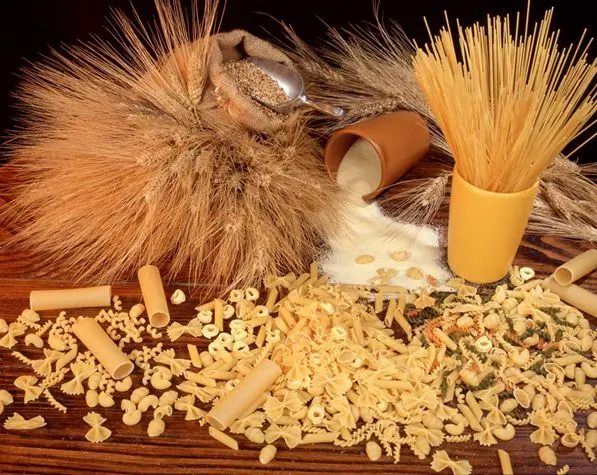
Durum wheat (Triticum turgidum) with pasta products made from durum wheat. Photo by Jean Weber (flickr, Creative Commons Attribution 2.0 Generic license, image resized).
Dr Madgwick became, somewhat by accident, a plant molecular biologist: She applied to read biology at Oxford, only to be told at interview that there was no such course - ‘would it be botany or zoology?’ She opted for botany and a doctorate, funded by the Medical Research Council, on the mechanisms of antibiotic resistance in bacteria. Then came a postdoctoral position at Rothamsted Research, the oldest agricultural research institute in the country, where I worked with wheat gluten. After the arrival of her three boys, she caused a rumpus by asking to work part-time, but eventually this request was accepted. For the following 25 years, she worked on exploring aspects of photosynthesis until she applied for voluntary redundancy in 2015. She was ordained in 2007 and worked in both church and science in parallel until 2015, then pursued a 2-year embroidery course. In 2017, they moved to Rutland so she could be Rector of 10 tiny rural parishes, and finally Graham and she retired here in 2024.
Last Updated on 29th September 2025